
 Feature
Japan’s autumn 2026 data breaches spread through the services companies use: reading 85 disclosed incidents
October brought 233 disclosures, the most on record. We list the main incidents from September to November 11 and use the data to explain how the numbers are counted, how the damage spreads, and what happens after a leak.
The largest breach happened at a company others had hired to send their emails. The counts cannot be added up, and the first figures change in follow-up reports. Start by checking a list of “where we keep our customers’ data.”
In October 2026, 233 cyberattacks and similar incidents were disclosed in Japan. That was the most for any month on record, about 2.4 times the previous high of September 2024. About 185 million items of personal information were leaked, nearly double September’s figure (ANN report, November 9, 2026).
Almost every day, the news carried the name of another company: a yakiniku chain’s app, a parcel delivery firm, an online furniture store, game IDs, a local government’s email newsletter. Following them one at a time makes it harder, not easier, to see what is going on.
So we listed the 85 main incidents disclosed between September 1 and November 11, and checked them against a research firm’s tally and the companies’ own announcements. Laid side by side, incidents that looked unrelated share three things.
First, the largest leaks did not happen at the companies that disclosed them, but at another company’s service to which they had handed their email delivery. Second, the reported counts use different units and cannot be added up. Third, the leaked information does not stop there: it becomes material for the next attack.
01Leaked records reached 7.6 times the previous year’s total in ten months
First, let us check the overall scale.
The research firm MM Research Institute has counted, incident by incident since 2022, the leaks (including possible leaks) caused by cyberattacks that Japanese organizations have disclosed. Its tally published on November 4, 2026 shows 661 incidents and about 376 million leaked records in 2026 through the end of October. For all of 2025 the figures were 428 incidents and 49.53 million records. The number of incidents is about 1.5 times higher, but the number of leaked records reached about 7.6 times the previous year’s total in just ten months.
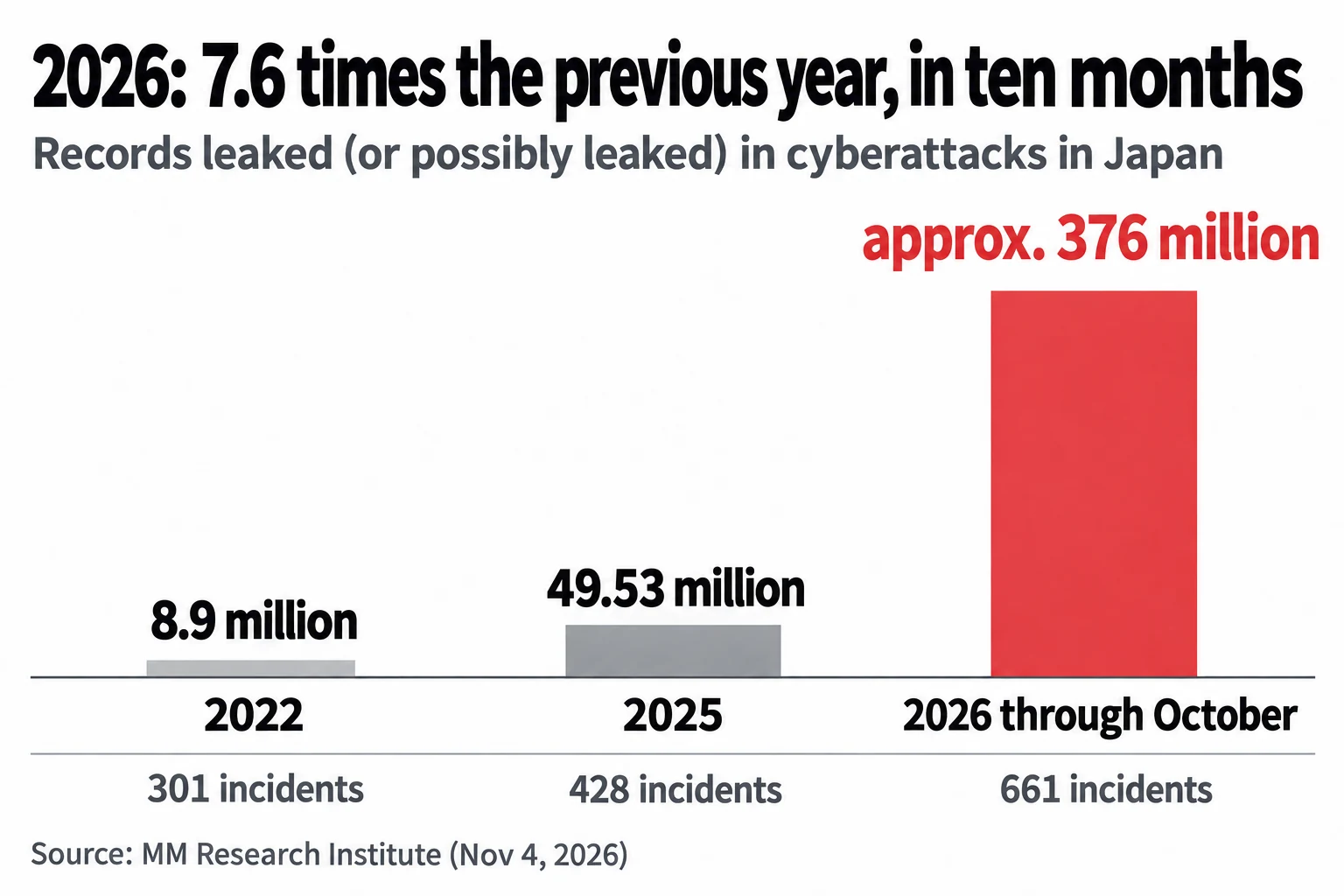
Moreover, most of it is concentrated after the summer. About 94% of the items leaked in 2026 came from incidents disclosed in July or later.
October did not just bring more incidents. In MM Research Institute’s count, October had 193 incidents, more than double September’s 81. The size of each incident changed too. Line the incidents up by the number of records leaked, and the one in the middle (the median) went from 1,500 records in September to about 29,000 in October. October alone had 30 incidents involving more than a million records.
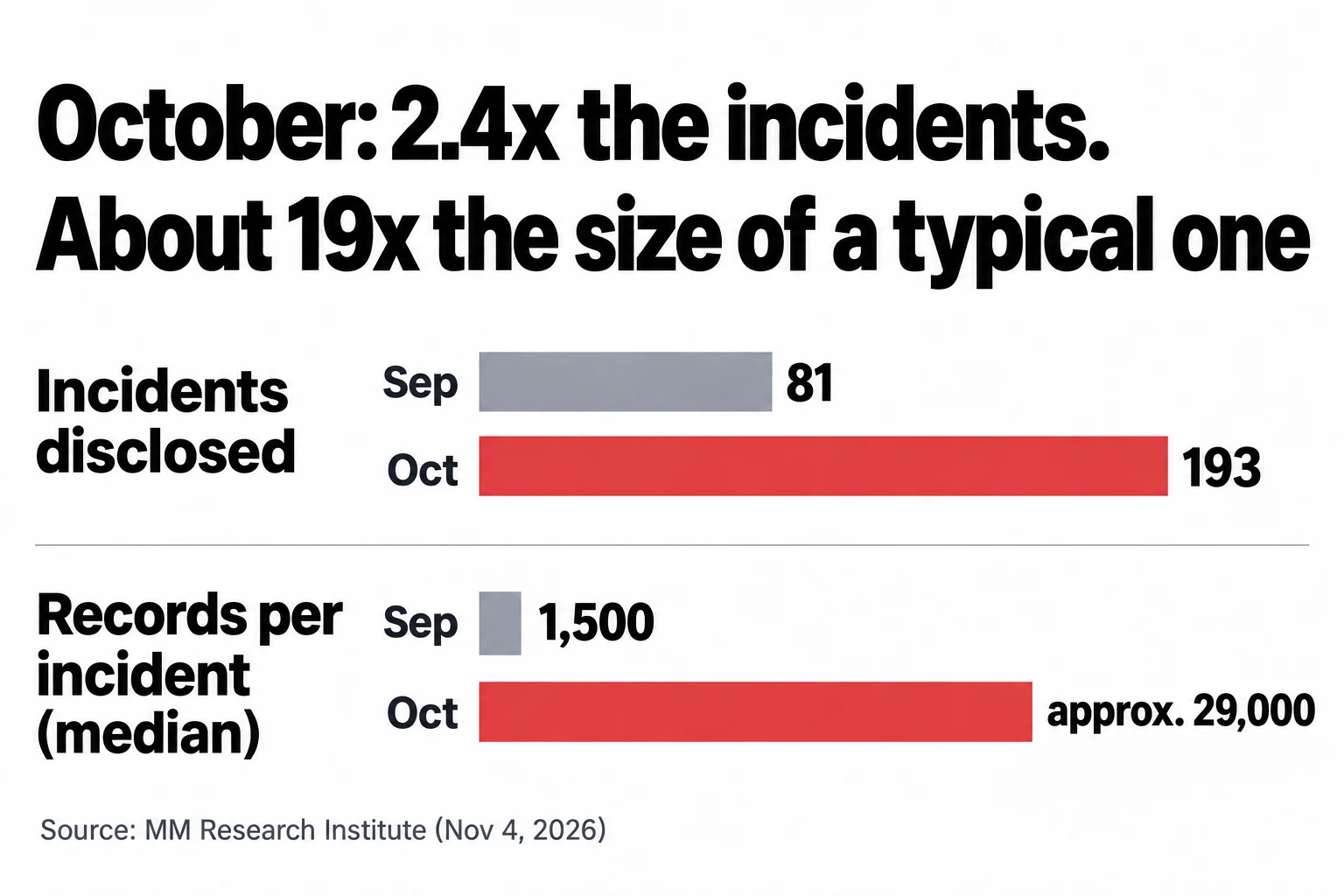
In other words, it was not only a few giant incidents that were large: the typical incident grew. The sections that follow look at why.
Note that ANN’s 233 and MM Research Institute’s 193 are counted differently. MM Research Institute treats disclosures by several organizations about an attack on the same contractor as one incident, and excludes human errors such as misdirected emails and lost items. Under either count, October was the highest month in its own tally.
02The reported counts use different units, so they cannot be added up
Building the list raises a problem right away: each incident is counted in a different unit. E-Store reported de-duplicated people, Sagawa Express records per parcel, Times Car accounts, and ARARA email addresses.
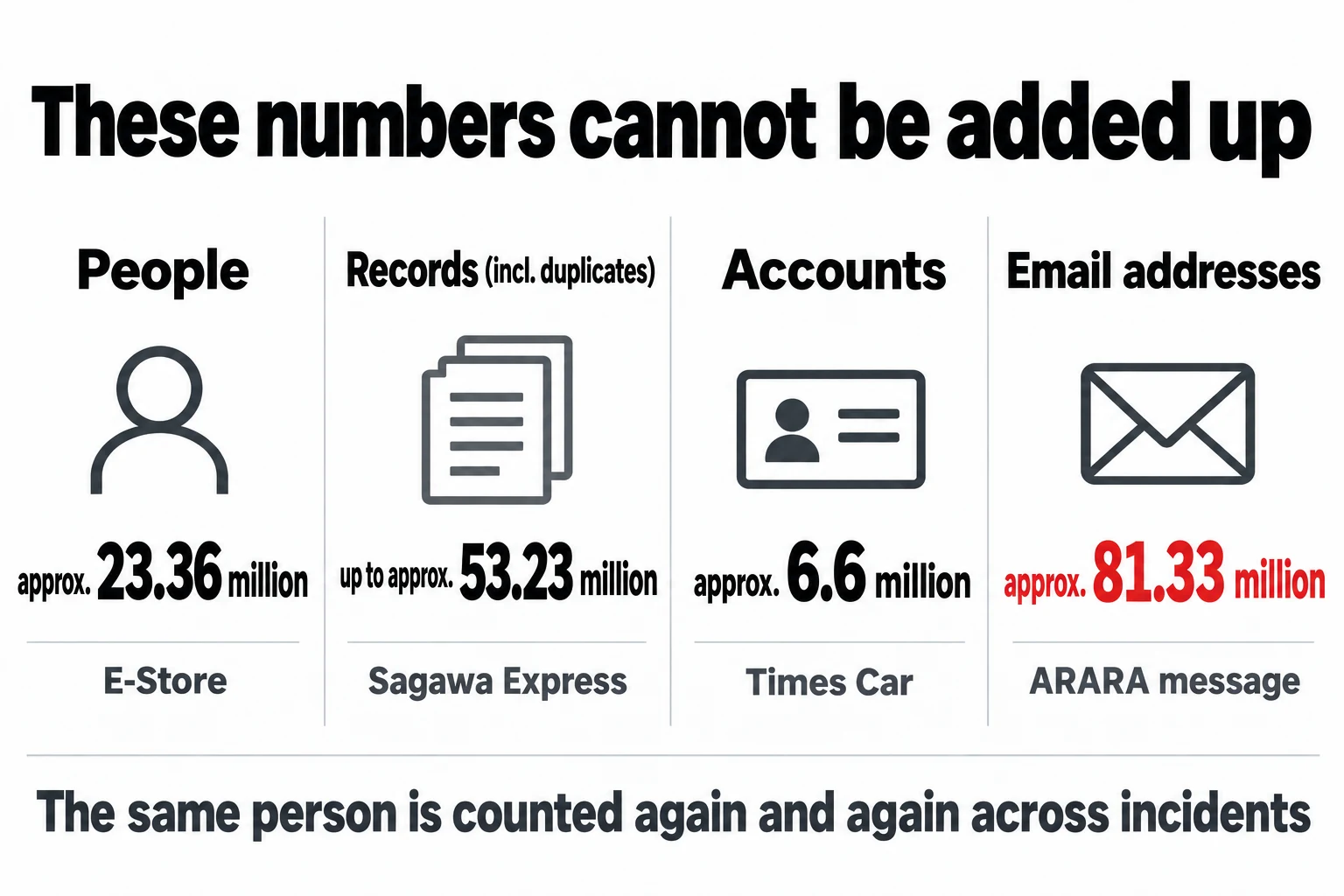
Sagawa Express’s count covers information on parcels handled over about 100 days, from late June to September 30, 2026; a person who sends several parcels is counted each time. ARARA’s count is the number of recipient email addresses, and one person may have several addresses. Gyazo’s about 23.62 million includes anonymous, unregistered accounts. On top of that, one person may be counted as a parcel recipient, as an online store member and as a game ID holder.
So you cannot add up the counts of the 85 incidents and say that “information on hundreds of millions of people was leaked.” What you can say is that your own information is likely to be in at least one of them.
03The largest leaks happened at the services companies trusted with their email
Because the units differ, the incidents cannot be ranked precisely by size. Even so, line up the incidents in the tens of millions and you find companies most people have never heard of.
ARARA, with the largest number, runs an “email delivery service” that sends newsletters and notices on behalf of companies and local governments. Ymirlink’s Cuenote, with about 47.86 million records, is the same kind of email delivery service. E-Store rents out the systems that many merchants use to run their online shops.
When such a company is breached, the dozens or hundreds of organizations that had entrusted data to it all disclose “possible leaks” at once. ARARA is estimated to have up to about 380 client companies, and Nikkei xTECH alone had confirmed at least 116 disclosures, excluding local governments, by November 9. MOS Food Services (about 7.52 million items), SEGA (about 2.2 million), the Cabinet Office (about 63,000) and the City of Kobe (about 21,000) did not have their own systems breached; the data they had entrusted to ARARA was leaked. These counts are part of ARARA’s about 81.33 million.
Email delivery services stand out in particular. According to piyolog, which keeps a record of security incidents, intrusions were found at five email delivery services in the 16 days from October 11 to 27.
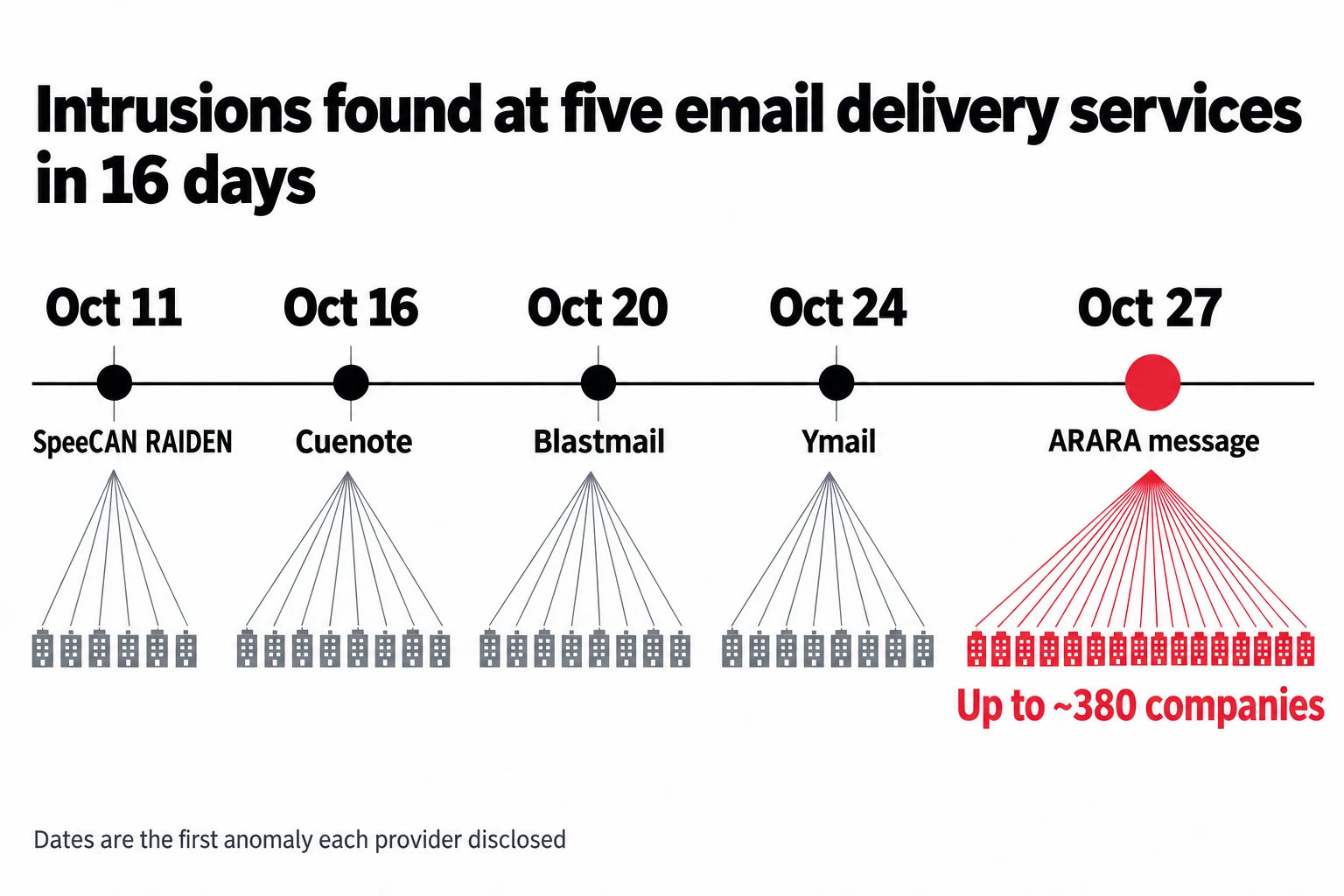
| Date | Service (company) | Known cause |
|---|---|---|
| 10/11 | SpeeCAN RAIDEN (Arcadia) | A vulnerability in a media server, and internal logins using a leaked key |
| 10/16 | Cuenote (Ymirlink) | Vulnerabilities in a library and a program. A support staff member’s credentials were stolen |
| 10/20 | Blastmail (Rakus Lite Cloud) | Intrusion into two API servers. The route is under investigation |
| 10/24 | Ymail (Igrex) | From an intrusion into the portal site’s server to customers’ delivery environments |
| 10/27 | ARARA message (ARARA) | A web server vulnerability and problems in the system environment. Start date and route under investigation |
None of the companies has said whether the five intrusions were the work of the same attacker. They appear to coincide with the night of October 21, when a fix for a serious vulnerability in the PHP programming language was released, but three of them, SpeeCAN RAIDEN, Cuenote and Blastmail, began earlier, and no company has pointed to a link with PHP. Still, the targets have something in common. An email delivery service holds the customer email addresses of many organizations in one place. From the attacker’s side, breaking through a single entrance reaches the data of hundreds of organizations.
In our list, too, at least 11 of the 85 incidents happened at a party the disclosing organization had entrusted data to (a contractor, an email delivery service, a cloud provider or a booking system). They include MOS, SEGA, the Cabinet Office, the City of Kobe, Shogakukan (email delivery), JAL and ANA (the Amadeus airline booking system), Daiichikosho (a contractor’s PC) and Ride On Express (its server operator). In at least 9 more, such as Ymirlink and IDC Frontier, the company breached was one that provides services to other companies.
This also shows in MM Research Institute’s tally by industry. In information and communications, the industry where incidents rose the most in 2026, 58 of the 176 incidents through the end of October involved breaches of cloud services for other companies (SaaS) or contractors’ systems. In 2025, it was 5 of 56.
Of course, many incidents involved companies’ own systems being breached directly. Leaks from the official apps of restaurant and retail chains such as Yakiniku King, Burger King, Matsuya, MrMax and MUJI were concentrated in September and October. However, no one has reported a common developer or membership system behind them.
Data is CITY looks at a company’s systems as a city. In city terms, however firmly you lock up your own building, if the management company holding your spare keys is broken into, intruders can get into your rooms. What happened in autumn 2026 is that intrusions into such management companies piled up, one after another, within a few weeks.
04Leaked information becomes material for scam emails and credential stuffing
A leak does not end when the data gets out.
When an email delivery service is taken over, attackers can send scam emails from that service under the genuine sender. At ARARA, from October 28 to 30, up to about 7.13 million emails posing as a credit card company were sent from ARARA’s addresses. Suspicious emails were also sent from SpeeCAN RAIDEN, about 1.42 million on October 13, and from Ymail, about 1.34 million by November 3. Because they come from addresses that usually send notices, they are hard to tell apart.
The other is passwords. In MM Research Institute’s tally, credentials such as passwords and login IDs leaked in 2026 reached a cumulative about 161 million by the end of October, about 31 times 2025’s figure. On November 11, it emerged that about 420,000 passwords for a service Ymirlink had shut down in February had been leaked unencrypted. Data from a discontinued service had been left in place rather than deleted.
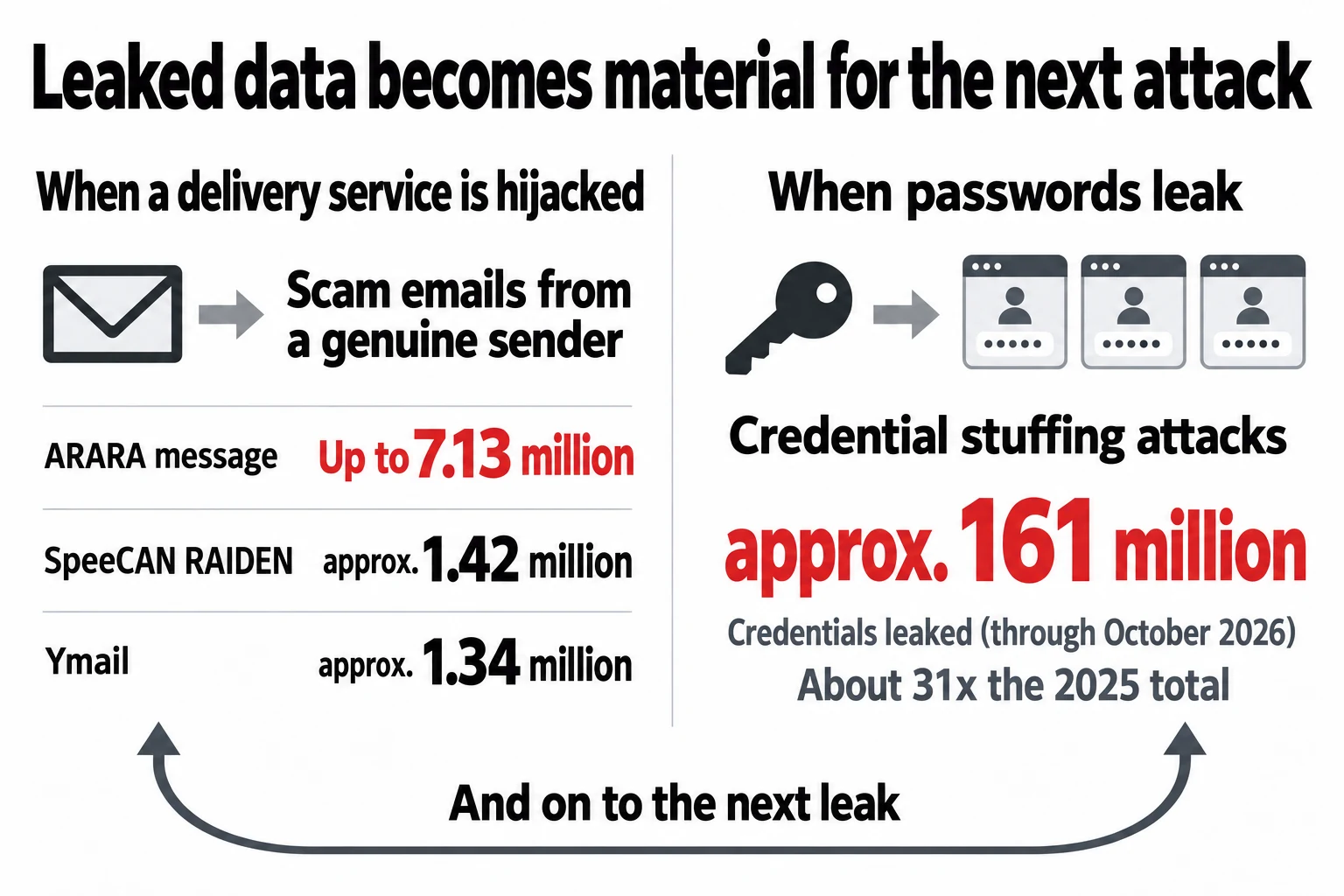
Leaked combinations of email addresses and passwords are used for “credential stuffing,” trying logins at other services one after another. If you reuse the same password, attackers can get into services that were not themselves breached. On November 9, Ryohin Keikaku disclosed that about 270,000 items may have been leaked from the MUJI online store through credential stuffing.
Leaks produce scam emails, and scam emails and credential stuffing produce the next leaks. Looking at each incident separately, you cannot see this cycle.
05The first figures announced change sharply in follow-up reports
Building the list revealed one more thing: the numbers move a lot after the fact.
Ymirlink estimated a cumulative about 9 million items in its first report on October 19, raised it to a cumulative about 51.63 million in its second report on October 26, and on November 11 settled on a cumulative about 47.86 million as the final figure. ARARA said in its first report on October 29 that “no leak has been confirmed,” but in its third report on November 6 disclosed a leak of about 81.33 million items.
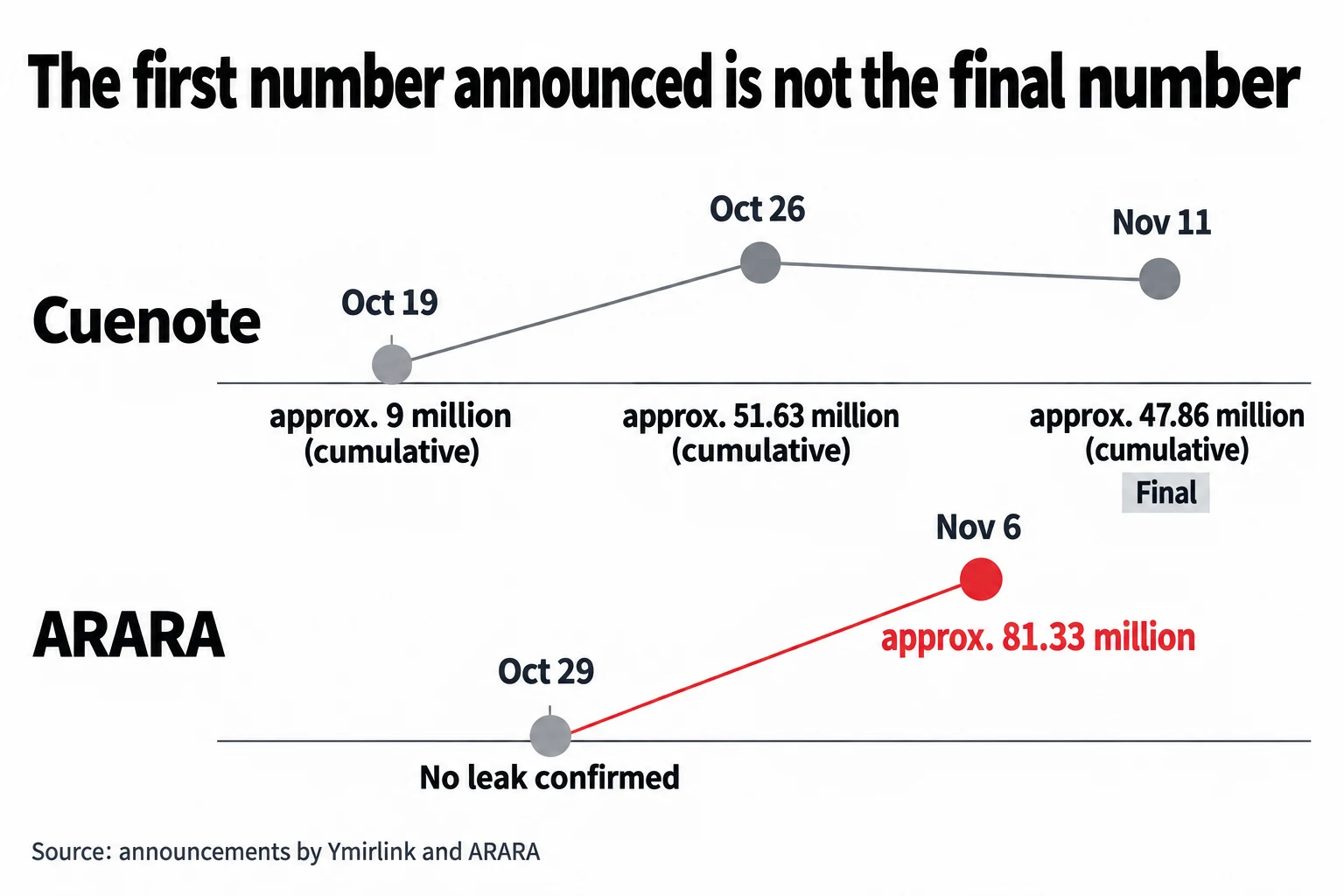
It can take months from an attack to its disclosure. Even in our list, Nichirei disclosed on September 18 an attack from July, and E-Store issued its final report on October 16 on attacks from May to August.
When the incident is at a contractor, the company that entrusted the data learns of it even later. SEGA was told by ARARA on November 1 that there “may have been external access,” was informed on the 3rd that data removal had been confirmed, and disclosed on the 9th. Nikkei xTECH’s reporting also found cases where a leak was later confirmed at a company first told it was “not affected.”
So even if the first announcement makes you think “this doesn’t concern us” or “the numbers are small,” you need to keep watching the follow-up reports.
06What companies should check starts with a list of where their data is kept
Companies can learn a lot from this autumn’s incidents. Four things in particular can be started right away.
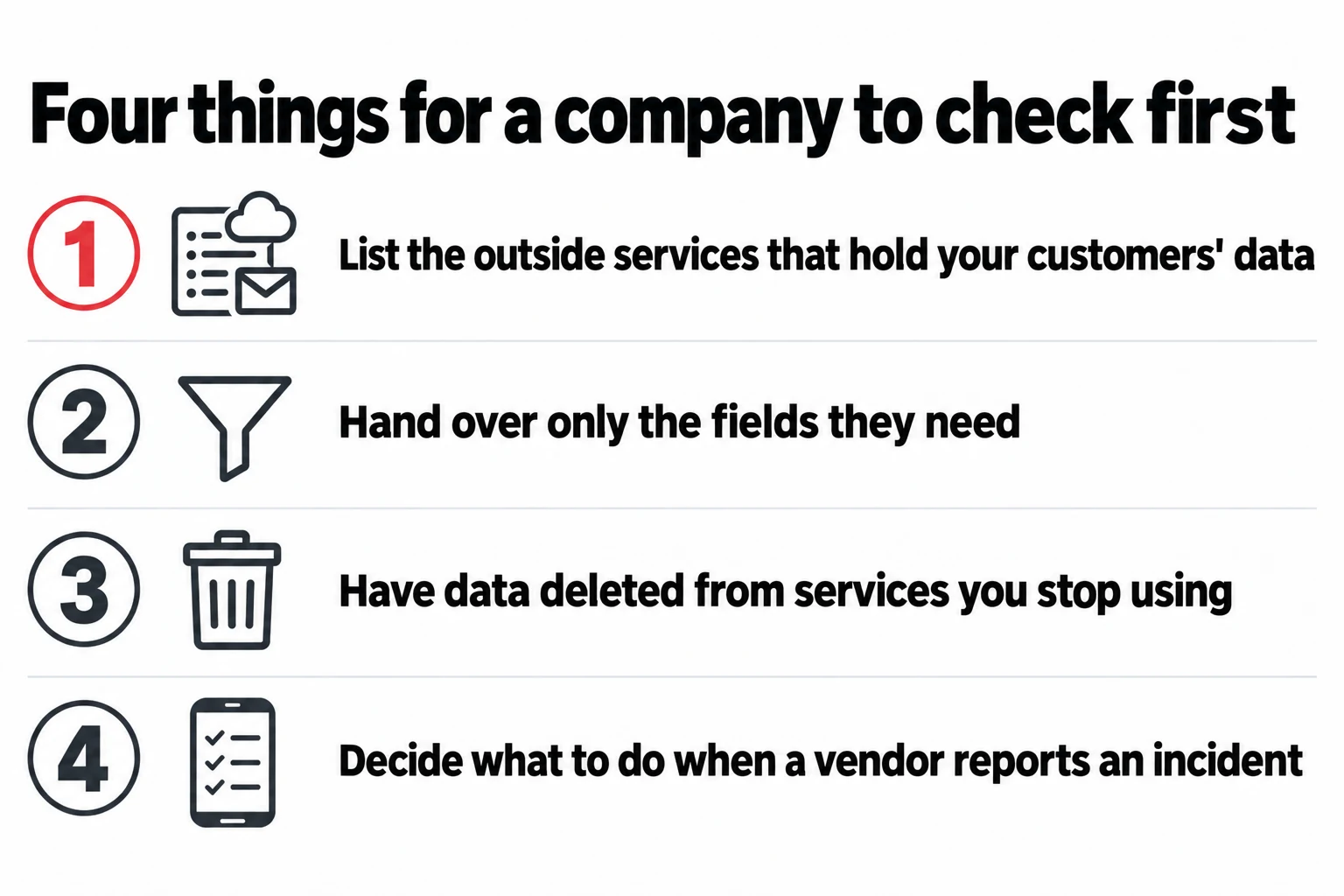
First, list the outside services that hold your customers’ data. Email delivery, booking management, membership apps, online shops, surveys, campaign entries, recruitment management. It is not unusual for each department to sign its own contracts, so that no one in the company knows them all.
Second, entrust only the items that are needed. Of the about 81.33 million items leaked at ARARA, about 47.04 million included information other than email addresses, such as names and dates of birth. Sending emails should not require anything beyond the email address.
Third, have the data of discontinued services deleted. The passwords leaked at Ymirlink belonged to a service shut down in February. When a contract ends, confirm that the data has been deleted.
Fourth, decide in advance what to do when a vendor contacts you. Who receives the notice, what to check, and when to inform customers and the Personal Information Protection Commission. Assume that the figures in the first report will change.
We turned the four points into a checklist you can take straight into an internal meeting. The front has checkboxes; the back has a table where each department lists the services that hold its data, and a section for the steps to take when a vendor reports an incident.
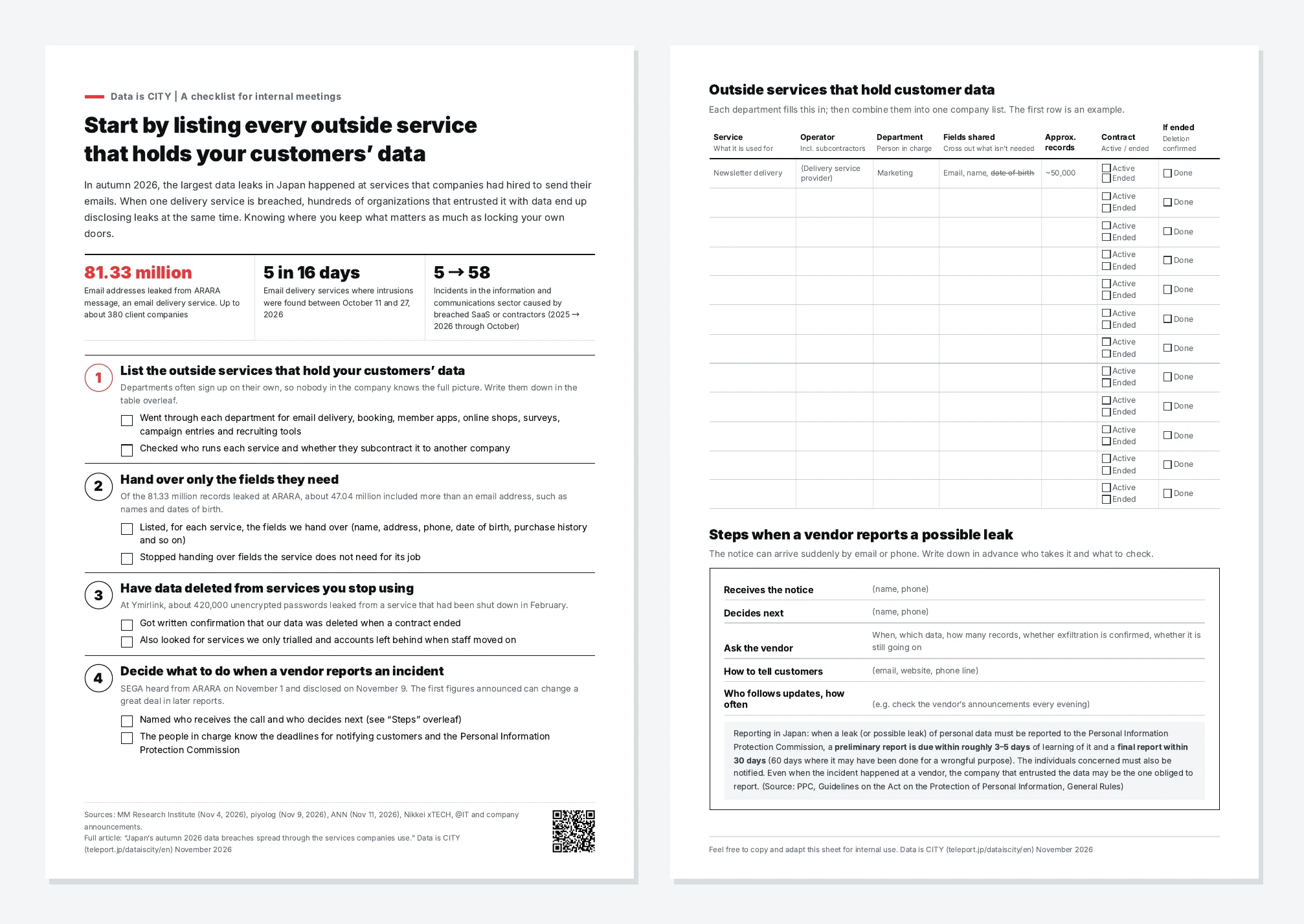
Files you can print and hand out
Downloads require registering your email address. On a device you have registered once, files download directly.
In-app browsers such as Facebook’s may not be able to download files. Tapping opens the file directly. To download it, choose “Open in browser” from the menu at the top right and open the page in Safari or Chrome.
There are also things each person can do: don’t reuse passwords, and use two-step verification wherever a service offers it. And even when a notice arrives from the company’s usual address, don’t log in through the link in the email; open the service from its official app or a bookmark.
07List of the main incidents disclosed from September 1 to November 11
This is the source material behind the analysis. The 85 rows include a follow-up to the same incident (Sony Life) and a separate incident at the same company (Ryohin Keikaku). [Vendor] marks incidents that happened at a service the disclosing organization relied on (a contractor, email delivery, cloud and so on); [Provider] marks breaches of a company that provides services to other businesses. Figures are as of each disclosure and mix confirmed counts, maximum possible counts, records and accounts. They cannot be added together.
September
| Date | Organization | Scale and details |
|---|---|---|
| 9/1 | Mitsui Fudosan | About 55,000 items. Unauthorized access to group systems |
| 9/7 | Musashino University | Ransomware damage to the systems of the university and its affiliated schools |
| 9/9 | ApplyNow | [Provider] Unauthorized access to a recruitment management service. About 390,000 people affected |
| 9/11 | Digital Agency | Intrusion into the Government Solution Service (GSS) network. About 246,000 items possibly leaked |
| 9/11 | Rohto Pharmaceutical | Unauthorized access to its mail-order system. A later investigation confirmed leaks on about 2.8 million people |
| 9/15 | Murauchi.com | Confirmed removal of about 7.71 million customer records from its online store (first report in July) |
| 9/16 | Helpfeel (Gyazo) | About 23.62 million items of user information (including anonymous accounts) leaked, plus about 490 million items of image metadata |
| 9/18 | Nichirei | Disclosed a leak of about 54,000 items. The attack was in July |
| 9/24 | EPARK Relax & Esthe | Leak of about 22.18 million records (first report in July) |
| 9/25 | Fines | About 1.54 million items possibly leaked from a booking service |
| 9/25 | Park24 (Times Car) | Leak of about 6.6 million accounts, about 1.6 million of them with images such as driver’s licenses |
| 9/25 | Saga University | Ransomware damage to an administrative server |
| 9/26 | Keio Corporation group | Ransomware damage. Outages in group systems |
| 9/27 | Starts Publishing (OZmall) | Personal information on up to about 443,000 people possibly leaked |
| 9/28 | Temairazu | [Provider] Intrusion into a hotel booking management service. Up to about 4.45 million people affected |
| 9/29 | Yamato Transport | Unauthorized access to Kuroneko deferred payment. A later investigation found about 5.26 million items affected |
| 9/29 | Seicomart | Personal information on about 575,000 app members leaked |
| 9/30 | Shudo Gakuen | Server intrusion. Information on staff, business partners and others possibly leaked |
October
| Date | Organization | Scale and details |
|---|---|---|
| 10/2 | Osaka Metropolitan University | System outage related to ransomware. Classes also affected |
| 10/5 | Daiwa Securities | [Vendor] Unauthorized access to a contractor’s FAQ system. About 110,000 people affected |
| 10/5 | Monogatari Corporation (Yakiniku King) | About 10.79 million items leaked from its official app |
| 10/6 | GMO Research & AI | Up to about 950,000 items from a survey service |
| 10/6 | MrMax | Up to about 1.74 million people from its app and online store |
| 10/7 | IDC Frontier | [Provider] Ransomware attack on its cloud platform. Services of 495 companies and local governments went down |
| 10/8 | Daiichikosho | [Vendor] Malware infection of a contractor’s PC. About 8.72 million items possibly leaked |
| 10/9 | Adventure (skyticket) | About 14.64 million items of travel booking customer information |
| 10/9 | BOOKOFF Group | Information on about 6.38 million members leaked |
| 10/13 | Ride On Express (Gin no Sara and others) | [Vendor] Ransomware damage at its server operator. Up to about 6.5 million items possibly leaked |
| 10/15 | Yellow Hat | About 1.8 million people from its service booking system |
| 10/15 | Burger King | About 11.18 million items of official app member information |
| 10/15 | SourceNext | Up to about 22.52 million items of member information possibly leaked |
| 10/16 | Nikkei Inc. | Credentials for a development cloud were stolen; about 1.83 million items leaked |
| 10/16 | E-Store (Shopserve) | [Provider] Final report on a leak of about 23.36 million people. Attacks from May to August; first report in August |
| 10/19 | Ymirlink (Cuenote) | [Provider] Intrusion into its email delivery platform. On 11/11, confirmed a leak of a cumulative about 47.86 million items |
| 10/19 | Hankyu Hanshin Department Stores | About 1.26 million items of member information leaked |
| 10/20 | NEC’s development and maintenance contractor | [Provider] Credential-stealing attack. Spread to several customers’ environments |
| 10/21 | Osaka University | [Vendor] Information on 77,851 people leaked via a contractor |
| 10/21 | Recruit (Carsensor) | Up to about 3.71 million items of customer information possibly leaked |
| 10/21 | NTT Solmare (Comic C’moA) | About 4.2 million items possibly leaked. Service suspended |
| 10/21 | GMO Internet | [Provider] Unauthorized access to cloud services and others. About 27,000 items affected |
| 10/22 | Capcom | About 11.77 million items of CAPCOM ID information leaked |
| 10/23 | Sagawa Express | Follow-up on an attack found on September 30. Up to about 53.23 million items possibly leaked |
| 10/23 | Lindt Japan | About 3.14 million items leaked from its mail-order service |
| 10/27 | Sony Network Communications | Confirmed a leak of about 2.14 million items of member information for So-net and other services |
| 10/28 | Hana Cupid | About 4.24 million items of member information leaked |
| 10/28 | Sony Life Insurance | About 385,000 items related to Medicare Life leaked. In November, about 2.9 million items of its own contract information too |
| 10/28 | JAL, ANA and others | [Vendor] An attack on the Amadeus airline booking system spreads. Passenger information on about 92,000 people at JAL and about 37,800 at ANA possibly leaked |
| 10/29 | ARARA (ARARA message) | [Provider] Attack on its email delivery service. Its third report on 11/6 said about 81.33 million email addresses were leaked or possibly leaked |
| 10/30 | Ryohin Keikaku (MUJI app) | Up to about 27.26 million items of personal information possibly leaked |
| 10/30 | Matsuya Foods | About 2.38 million items of customer information leaked from its official app and other channels |
| 10/30 | Yakult Honsha | About 40,000 items leaked from its inquiry form and other channels |
| 10/30 | Ministry of Foreign Affairs | Intrusion into an external network. About 3,600 items possibly leaked |
November (through the 11th)
| Date | Organization | Scale and details |
|---|---|---|
| 11/2 | Prestige International | Unauthorized access to business systems. Up to about 5.5 million items of customer information affected |
| 11/2 | istyle | Confirmed leak of personal data of about 3 million @cosme members |
| 11/4 | MOS Food Services | [Vendor] About 7.52 million email addresses and other items leaked in the attack on ARARA, its email delivery contractor |
| 11/5 | NTT DOCOMO | Attack on docomo Online Shop and My docomo. Up to about 300,000 items of customer information leaked |
| 11/5 | SMBC Consumer Finance | Unauthorized access to a guarantee system. Information on up to about 320,000 people leaked |
| 11/5 | Matsui Securities | About 830,000 email addresses leaked |
| 11/6 | Aioi Nissay Dowa Insurance | About 444,000 items leaked |
| 11/6 | SUBARU | Up to about 229,000 items of personal information possibly leaked |
| 11/7 | Club Tourism | About 4.32 million items possibly leaked. Investigation continues after the first report on 10/31 |
| 11/7 | Signal Talk (Maru-Jan) | About 1.856 million accounts leaked |
| 11/9 | Nitori Holdings | Up to about 37.62 million items of customer information possibly leaked |
| 11/9 | Sharefull | Up to about 7.5 million user items and up to about 7,500 corporate clients possibly leaked, including face photo URLs and bank account information |
| 11/9 | Sony Life Insurance | Follow-up on an attack found in October. Confirmed a leak of about 2.9 million items of its own insurance contract information |
| 11/9 | NTT DATA (Sumitomo Life Vitality) | Personal information on about 80,000 people leaked from a related service |
| 11/9 | SEGA | [Vendor] About 2.2 million email addresses leaked in the attack on ARARA |
| 11/9 | RAKSUL | Unauthorized access to its file submission system. Print data and other information possibly leaked |
| 11/9 | Waseda University | Intrusion into MyWaseda’s information management system. Retrieval of a cumulative 3,342 items confirmed |
| 11/9 | teket | Intrusion into its e-ticket service. Part of the information on all members leaked |
| 11/9 | OPEN DOOR (Travelko) | About 382,000 email addresses leaked |
| 11/9 | Rafool Survey | [Provider] Employee information on 24,232 people at 182 companies was taken |
| 11/9 | Shogakukan | [Vendor] About 1.99 million items possibly leaked in an attack on its email delivery contractor |
| 11/9 | Giken | Ransomware attack on a business server. Information on about 3,200 people possibly affected |
| 11/9 | Ryohin Keikaku (MUJI online store) | Separately, about 270,000 items possibly leaked through credential stuffing |
| 11/10 | Japan Chamber of Commerce and Industry | Attack on its online exam management system. Information on up to about 980,000 test takers possibly leaked |
| 11/10 | SOFT99 | Attack on its online store. Personal information on up to 136,968 people possibly leaked |
| 11/10 | Kirin Brewery and Kirin Beverage | [Vendor] Attack on an external campaign tool. 1,825 items of participant information leaked |
| 11/10 | City of Kobe | [Vendor] About 21,000 email addresses leaked in the attack on ARARA, its email delivery contractor |
| 11/11 | SMBC Nikko Securities | Information on up to 56,487 employee stock ownership plan members possibly leaked |
| 11/11 | Cabinet Office | [Vendor] 62,863 items of email newsletter registration information leaked |
| 11/11 | FABRIC TOKYO | Unauthorized access to a test system. Booking information on 699 people possibly leaked |
| 11/11 | Dentsu Digital | An administrator account for “TONARIWA” was compromised; personal information possibly leaked |
| 11/11 | PICKS | Personal information on 8,312 people leaked from a mobile ordering service |
| 11/11 | Tin Pan Alley | A cumulative about 1.2 million items of member information may have been leaked |
About this article
Written by the Data is CITY Media editorial team, based on a list of the main cyberattacks and data leaks disclosed in Japan from September 1 to November 11, 2026, with further research. The list is a selection of the main incidents, not every incident. Counts are the values at the time each organization disclosed them and may change in follow-up reports.
The figures in the analysis come from MM Research Institute’s tally (disclosures through October 31, 2026), the companies’ announcements, and summaries by piyolog and news reports. None of the companies has disclosed whether the five email delivery service incidents were the work of the same attacker, or whether the attacks used AI. This article treats them the same way.
References
- MM Research Institute, “Information leaked in cyberattacks reached about 380 million items by the end of October” (in Japanese, November 4, 2026)
- ANN, “Cyberattacks hit a record 233 in October; personal information leaked reaches 185 million, nearly double September” (in Japanese, November 9, 2026)
- piyolog, “A summary of the series of unauthorized access incidents at email delivery services” (in Japanese, November 9, 2026)
- piyolog, “A summary of the unauthorized access to Ymirlink’s email delivery service Cuenote” (in Japanese, November 4, 2026)
- ANN, “Concerns over misuse in credential stuffing… Ymirlink’s leak count reaches about 47.86 million” (in Japanese, November 11, 2026)
- Nikkei xTECH, “ARARA’s data leak grows to 81.33 million: what 116 disclosures reveal about the damage” (in Japanese)
- @IT, “SEGA’s 2.2 million leak is the tip of the iceberg: 81 million email addresses leaked through a contractor breach” (in Japanese, November 11, 2026)